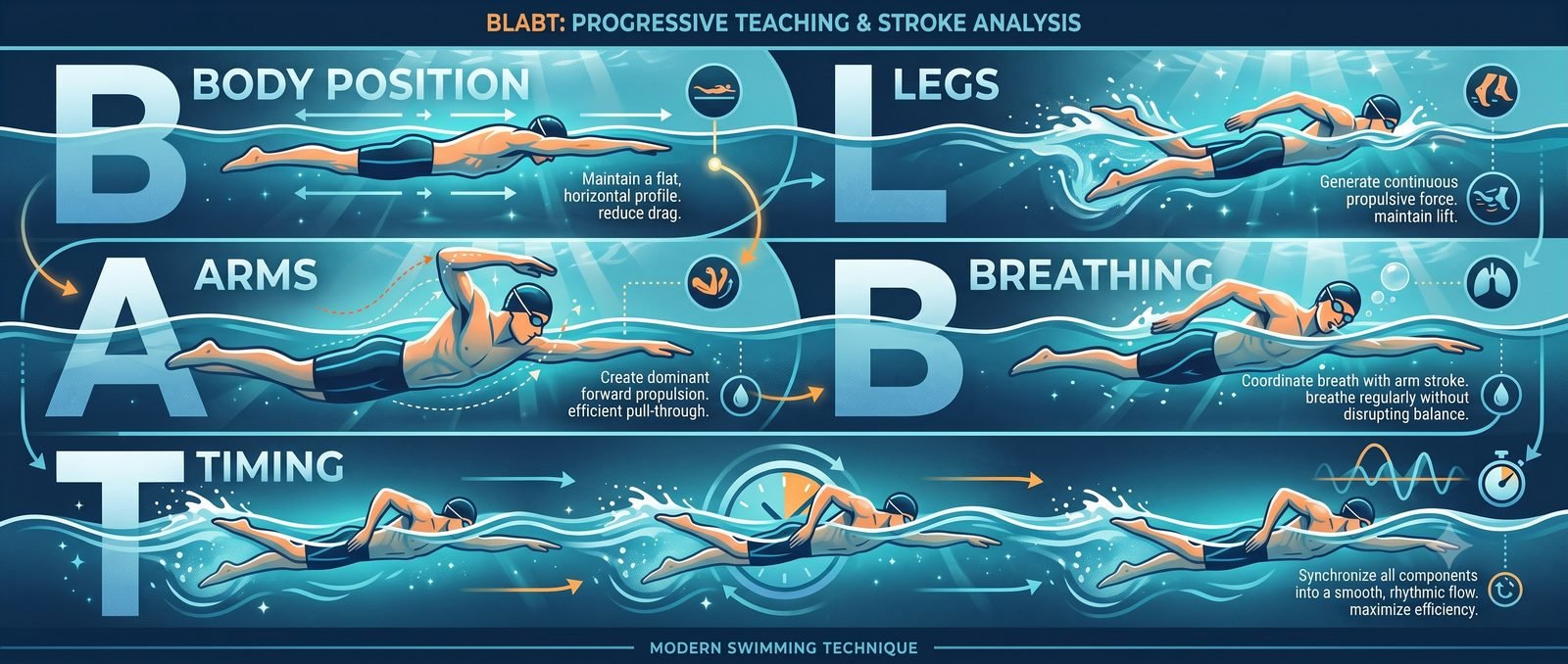
If you have ever wondered how a swimming teacher turns a nervous beginner into a confident swimmer, the answer often comes down to five letters: BLABT. BLABT is a stroke teaching framework that breaks every swimming stroke into five manageable parts: Body position, Legs, Arms, Breathing and Timing. Learners master one piece at a time instead of being overwhelmed by the whole stroke at once. It is used by qualified swim coaches worldwide, including our team at 02H Swim School, to teach front crawl, backstroke, breaststroke and butterfly.
In this guide we explain exactly what BLABT stands for, why the order matters, and how it is applied to each of the four competitive strokes, with sample drills you can recognise in any well run lesson, including ours.
What Does BLABT Stand For?
BLABT is an acronym that sets out the order in which a stroke is taught. It stands for the sequence a coach follows: Body position first, then Legs, then Arms, then Breathing, and finally Timing.
- B is for Body position. Getting the swimmer flat, streamlined and balanced in the water.
- L is for Legs. Developing a propulsive, sustainable leg kick.
- A is for Arms. Adding the arm action that provides most of the stroke's power.
- B is for Breathing. Introducing a breathing pattern that fits the stroke.
- T is for Timing. Coordinating all the elements together into one smooth, full stroke.
The idea is simple but powerful. Coaches break each stroke into these five parts, and pupils perform specific drills tailored to one area of their technique at a time. Rather than asking a beginner to think about arms, legs and breathing all at once, the coach isolates one element, builds competence, then layers on the next.
Why the Order Matters
BLABT is deliberately sequential. A swimmer who cannot hold a flat, balanced body position will struggle to kick efficiently, and a swimmer fighting to stay afloat has no spare attention for breathing rhythm. By starting with body position and finishing with timing, the framework builds each skill on a stable foundation.
This is also why BLABT works so well alongside a structured learn to swim pathway. It is a framework for introducing and developing each of the four competitive strokes, and it pairs naturally with an Introduce, Develop, Master approach, where a skill such as a leg kick is introduced early, developed over several stages, and mastered later on.
When Are Learners Ready for BLABT?
BLABT is stroke work, so it comes after a child is comfortable and mobile in the water. Before formal strokes, the goal is water confidence and acclimatisation. Our own Learn to Swim programme follows exactly this path. As a broad rule of thumb, most children are ready for the formal introduction of stroke work from around the age of 5.
Different coaches start with different strokes depending on their preferences and experience. Most begin with front crawl, though some choose backstroke. There is no single correct first stroke. A good coach reads the learner.
BLABT Applied to Each Stroke
Here is how the framework translates into real drills for each of the four strokes, the same progression our coaches use in every 02H lesson.
Front Crawl
- Body position: push and glide from the poolside.
- Legs: kicking while holding a kickboard out in front.
- Arms: practising arm pulls with one arm while holding a float with the other.
- Breathing: trickle breathing while holding a float and kicking.
- Timing: front crawl catch up drill using a float or kickboard.
Breaststroke
- Body position: push and glide from the poolside.
- Legs: leg kicks with a float held under each arm.
- Arms: walking through shallow water using arm pulls.
- Breathing: slow arm pulls with a woggle for support, adding breaths.
- Timing: slow swimming with a woggle, practising the "pull, breathe, kick, glide" sequence.
Backstroke
- Body position: supine push and glide.
- Legs: kicking while holding a float under each arm.
- Arms: single arm pulls with a float held on the chest.
- Breathing: arm pull practice with an added in and out breathing pattern.
- Timing: full stroke, counting three leg kicks for each arm pull.
Butterfly
- Body position: dolphin dives.
- Legs: kicking in a supine position using floats for support.
- Arms: push and glide, adding arm pulls.
- Breathing: walking through shallow water, using arm pulls and including breaths.
- Timing: push and glide, building a "kick, pull, kick, recover" sequence.
Butterfly is often taught last because if the rhythm is learnt incorrectly, it is very hard to undo.
Why BLABT Works So Well
The strength of BLABT is that it reduces cognitive load. A full stroke is a complex, coordinated movement. Asking a beginner to perform all of it at once usually produces frustration and poor habits. By isolating each component with a targeted drill, learners get quick, visible wins that build confidence. Confidence is the single biggest driver of progress in the water.
It also gives coaches a shared language. Whether an instructor is working with an anxious adult or an energetic five year old, "let's fix your body position first, then add legs" is a clear, repeatable plan any swimmer can follow.
Frequently Asked Questions About BLABT
What does BLABT stand for in swimming?
BLABT stands for Body position, Legs, Arms, Breathing and Timing. It is the order in which a swimming coach breaks down and teaches each stroke.
Is BLABT used for all four strokes?
Yes. BLABT is applied to front crawl, backstroke, breaststroke and butterfly. The individual drills change for each stroke, but the five part structure stays the same.
At what age can BLABT be used with children?
BLABT is stroke work, so it usually begins once a child is comfortable and mobile in the water, generally from around age 5. Before that, lessons focus on water confidence and acclimatisation.
Which stroke should be taught first with BLABT?
There is no fixed rule. Most coaches start with front crawl, though some begin with backstroke. The choice depends on the coach's experience and the individual learner.
What is the last stage of BLABT?
Timing: coordinating body position, legs, arms and breathing into one smooth, full stroke. It comes last because it depends on the other four elements being in place.
See BLABT in Action at 02H
Understanding the framework is one thing. Watching a certified coach guide your child through it is another. Message us to book a free trial and see how our coaches use BLABT to build safe, confident swimmers, one stroke at a time.
Book a Free Trial on WhatsAppEvery stroke your child learns starts with the same five steps: body position, legs, arms, breathing and timing. Explore our stroke correction and technique programmes, meet our coaches, or read more on the 02H blog. We help students of all ages grow from Zero 2 Hero, safely.